5 workflow design principles for scalable AI content production
April 07, 2026

AI workflow design principles transform content production from one-off generation into structured, scalable systems that maintain quality, consistency, and efficiency as output volume grows.
Key things to know:
- Why AI content production is shifting from generation to workflow orchestration
- How starting with a clear production objective leads to better scalability and alignment
- Why breaking workflows into stages improves control, optimization, and reuse
- How preserving context across steps ensures consistency in tone, brand, and messaging
- Why branching and reuse are essential for handling multi-format and multi-channel content
- How scalable workflows reflect real content operations, not linear generation processes
- Why modular workflow design makes debugging and iteration faster and more efficient
- How workflow-first systems reduce manual corrections and hidden production costs
- Why evaluation must be embedded throughout the workflow to ensure reliable outputs
- How structured workflows turn AI content into repeatable, production-ready systems
- Why scalability depends on reproducibility, not just output quality
- How workflow-first platforms enable teams to move from experimentation to real production systems
The hardest part of AI content production is not generating output. It is building a system that can keep producing useful, consistent content as volume increases. Many teams can get strong results from a prompt, a model or a clever workflow experiment. Far fewer can turn that into a repeatable production process that holds up across campaigns, formats, stakeholders and deadlines.
That is the real shift happening in 2026. AI content production is becoming a workflow problem. As more teams generate blogs, ads, images, video assets, captions, scripts, repurposed content and campaign variations with AI, the bottleneck moves away from pure generation and toward orchestration. The question is not whether AI can help create content, but whether your team can build a production system that keeps quality high while making output faster, cheaper and easier to scale.
This is why workflow-first platforms like GMI Studio matter. The value is not just access to models. The value is the ability to design structured, reusable, multimodal workflows that turn creative operations into something more consistent and production-ready. If your content pipeline is growing, workflow design becomes one of the most important strategic decisions you make.
Here are five principles that matter most.
Start with the production objective
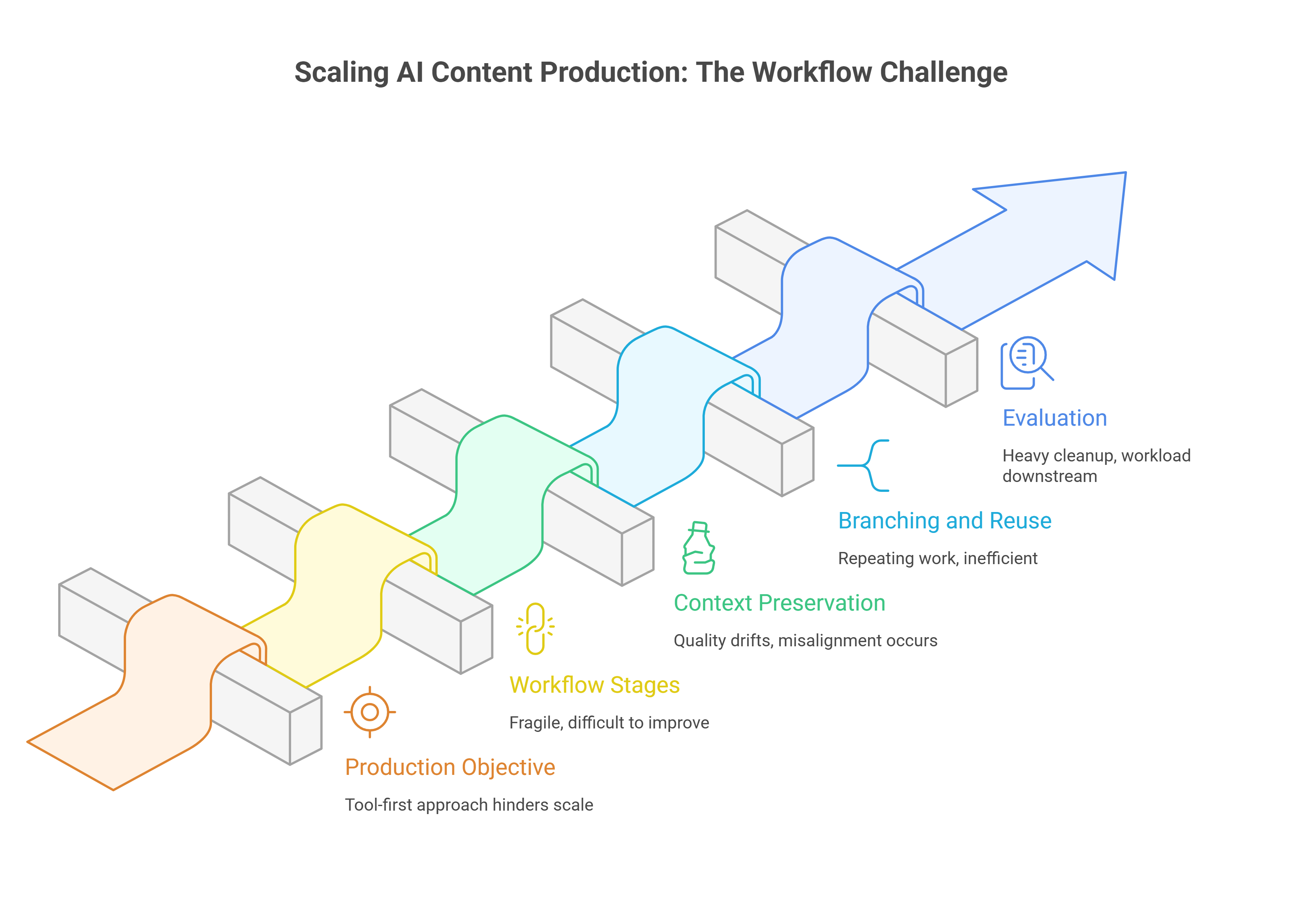
A lot of AI workflows begin with the tool. A team tests a model, sees an impressive output, and starts building around it. That is fine for experimentation, but it is the wrong way to design for scale.
Scalable workflows should begin with the production objective. What exactly are you trying to produce? How much of it? For which channels? With what turnaround time, quality standard and review process? Those questions shape the workflow far more effectively than choosing a model first.
A team producing high-volume campaign content may need to generate long-form articles, paid ad copy, image prompts, social captions, short-form video scripts and metadata from the same source brief. That is not one task. It is a system of connected tasks. If the team starts with the production goal, it becomes easier to map the steps, define the handoffs, and decide where different models or tools should be used.
This is also where GMI Studio fits particularly well. It supports the idea that workflows should be designed around output and execution, not just around the capabilities of a single model. In practical terms, that means you are not architecting around what one tool can do. You are architecting around what your production pipeline needs.
Break the workflow into stages
Scalable content workflows need structure. One long chain that takes a brief and tries to generate everything in one pass is fragile, difficult to improve, and hard to debug. A better approach is to break the workflow into clear stages.
For content production, those stages might include brief intake, context assembly, ideation, draft generation, editing, format adaptation, evaluation, approval and export. In a multimodal setting, there may also be steps for image generation, voiceover, transcription, video scripting or asset resizing across platforms.
This kind of modular design creates much more control. It allows teams to optimize specific steps without rebuilding the whole process. It makes failures easier to identify. It also makes reuse possible. If one ideation stage works well across campaigns, that logic can be used again. If one adaptation stage is effective for social content, it can become a repeatable part of the pipeline.
This is one of the biggest reasons workflow orchestration is becoming such a major category. Production does not happen in one generation step. It happens through multiple transformations, and each transformation needs its own place in the system.
Preserve context across every step
A workflow that only passes files is not enough. Scalable content production depends on preserving context from one step to the next.
That context includes the original brief, brand rules, tone of voice, audience, product details, channel requirements, source material, prior outputs and approval status. If that information gets lost between stages, content quality starts to drift. You end up with assets that are technically usable but misaligned with the campaign, the brand, or the intended audience.
This is where many AI content systems break under scale. In low-volume use, teams can manually correct inconsistencies. In high-volume production, that becomes a hidden cost. Too much time gets spent rewriting, clarifying and fixing outputs that should have stayed aligned from the start.
The better approach is to treat context like infrastructure. Each stage in the workflow should receive the inputs it needs to make good decisions and produce outputs that stay connected to the original objective. That is especially important in multimodal production, where one campaign may generate text, visuals, and video assets that all need to feel like part of the same system.
Prompt quality matters, but context continuity matters more when you are building for scale.
Design for branching and reuse
Content production is rarely a straight line. Teams explore different directions, generate multiple options, repurpose winning ideas, and adapt content across formats. A scalable workflow should be designed for that reality.
One brief might need to generate several campaign angles. One selected angle might need to turn into email copy, social assets, blog content, landing page text and visual prompts. One approved output might need to be localized, shortened or reformatted for different channels. If the workflow cannot branch and reuse logic efficiently, the team ends up repeating work that should already be systematized.
This is where workflow design starts to affect economics directly. Reuse lowers production effort. Branching increases creative flexibility without forcing the team to start over every time. A good workflow does not just automate generation. It creates a structure where successful steps can be repeated, adapted and scaled.
GMI Studio is especially relevant here because visual, node-based workflows make branching logic easier to build and easier to understand. Instead of relying on scattered prompts or disconnected tool chains, teams can build reusable systems that reflect the real shape of content production.
That is a much stronger foundation for scale than improvisation.
Build evaluation into the workflow
A fast workflow is not necessarily a scalable one. If content still needs heavy cleanup at the end, the system is only moving the workload downstream. Real scale requires built-in evaluation.
That means checking outputs as they move through the workflow, not waiting until the very end. Depending on the use case, evaluation might include structure checks, formatting checks, tone validation, brand alignment, completeness or human review gates. The goal is to catch problems early, before weak outputs move further through the production chain.
This principle matters because content operations need reliability, not just speed. Teams need to know that the workflow can produce usable outputs consistently, with less manual correction and less uncertainty. Evaluation makes that possible, and it also makes the workflow more measurable. Over time, teams can see where quality drops, where review slows down, and which stages need improvement.
This is one of the clearest differences between AI experimentation and AI production. Experimentation proves that a model can create something. Production requires a workflow that can create something useful, repeatedly, under real operating conditions.
The teams getting the most value from AI content production are not the ones chasing isolated outputs. They are the ones designing strong systems. Clear objectives, staged execution, preserved context, branching logic, and built-in evaluation are what make content workflows scalable in practice.
That is the bigger opportunity behind workflow-first platforms like GMI Studio. They allow teams to move from prompt-based experimentation to production-grade orchestration. And in 2026, that shift is where much of the real advantage will come from.
Build AI Without Limits
GMI Cloud helps you architect, deploy, optimize, and scale your AI strategies
FAQ
