
Image generation for brands requires more than creative prompts. Maintaining visual identity with AI depends on structured systems that ensure consistency, repeatability and scalable production across campaigns and platforms.
Key things to know:
- Why prompt-only image generation often leads to visual drift and inconsistent brand representation
- How brand identity relies on structured elements like color palettes, composition rules and lighting style
- The importance of encoding brand guidelines directly into AI generation workflows
- How reference images, style libraries and conditioning techniques improve visual consistency
- Why workflows allow controlled creative iteration without breaking brand identity
- How structured pipelines help brands generate large volumes of images across campaigns and regions
- The role of reproducibility and traceability in enterprise AI-generated visual assets
- How collaborative workflows align brand managers, designers and technical teams
For brands, visual identity is not optional. Color palettes, composition, tone, lighting and stylistic details all work together to create recognition and trust. When generative AI enters the picture, that consistency is often the first thing to break. A single image may look impressive, but repeated generations drift in style, tone and structure – undermining brand coherence instead of strengthening it.
This is why image generation for brands is less about creativity in isolation and more about control, repeatability and systems. Maintaining visual identity with AI requires moving beyond one-off prompts and into structured workflows that encode brand rules directly into the generation process.
For enterprises, this shift is not just aesthetic, but also economic. The goal is efficient velocity: producing visuals that are quick to generate, consistent in quality, and cost-effective to scale.
Why prompts alone fail brand consistency
Prompt-based image generation works well for exploration. Designers can experiment with styles, moods and compositions quickly. But once a brand needs to produce images repeatedly – across campaigns, regions or formats – prompts alone become unreliable.
Small wording changes can produce dramatically different outputs. Model updates introduce subtle shifts. Even the same prompt can yield inconsistent results across runs. For brands, this unpredictability creates risk. Visual identity becomes dependent on manual oversight rather than system design.
The core issue is that prompts are ephemeral, while brand identity is persistent. Bridging that gap requires a different approach. Without structure, the “good” in quick–good–cheap collapses into inconsistency, and the hidden cost of manual correction eliminates the “cheap”.
Visual identity as a system, not a style
Brand identity is not a single aesthetic choice, but a system of constraints. These constraints include color ranges, composition rules, subject positioning, lighting preferences, typography relationships and emotional tone. Human designers internalize these rules over time. AI systems need them encoded explicitly.
Generative workflows make this possible. Instead of embedding all brand logic into a single prompt, workflows distribute responsibility across stages. One step may define layout. Another may enforce color constraints. Another may validate outputs against reference examples.
By separating concerns, workflows reduce drift. Each generation passes through the same structure, ensuring that outputs remain aligned even as inputs vary.
In platforms like GMI Studio, this structure is represented visually, allowing teams to encode brand rules directly into reusable image pipelines rather than relying on fragile prompt memory.
The role of reference and conditioning
Maintaining visual identity often depends on reference. Brands already have libraries of approved imagery, style guides and visual motifs. AI workflows can incorporate these references directly into the generation process.
Rather than asking a model to “match the brand”, workflows can condition generation on curated examples. Reference images, embeddings or style vectors guide outputs toward a known visual space. This approach dramatically improves consistency compared to prompt-only methods.
Over time, these references become part of the workflow itself. New campaigns inherit visual identity automatically, reducing manual tuning and review cycles. Reusability here is key: once conditioning logic is defined inside a workflow, every future execution benefits – lowering marginal cost while maintaining visual quality.
Iteration without drift
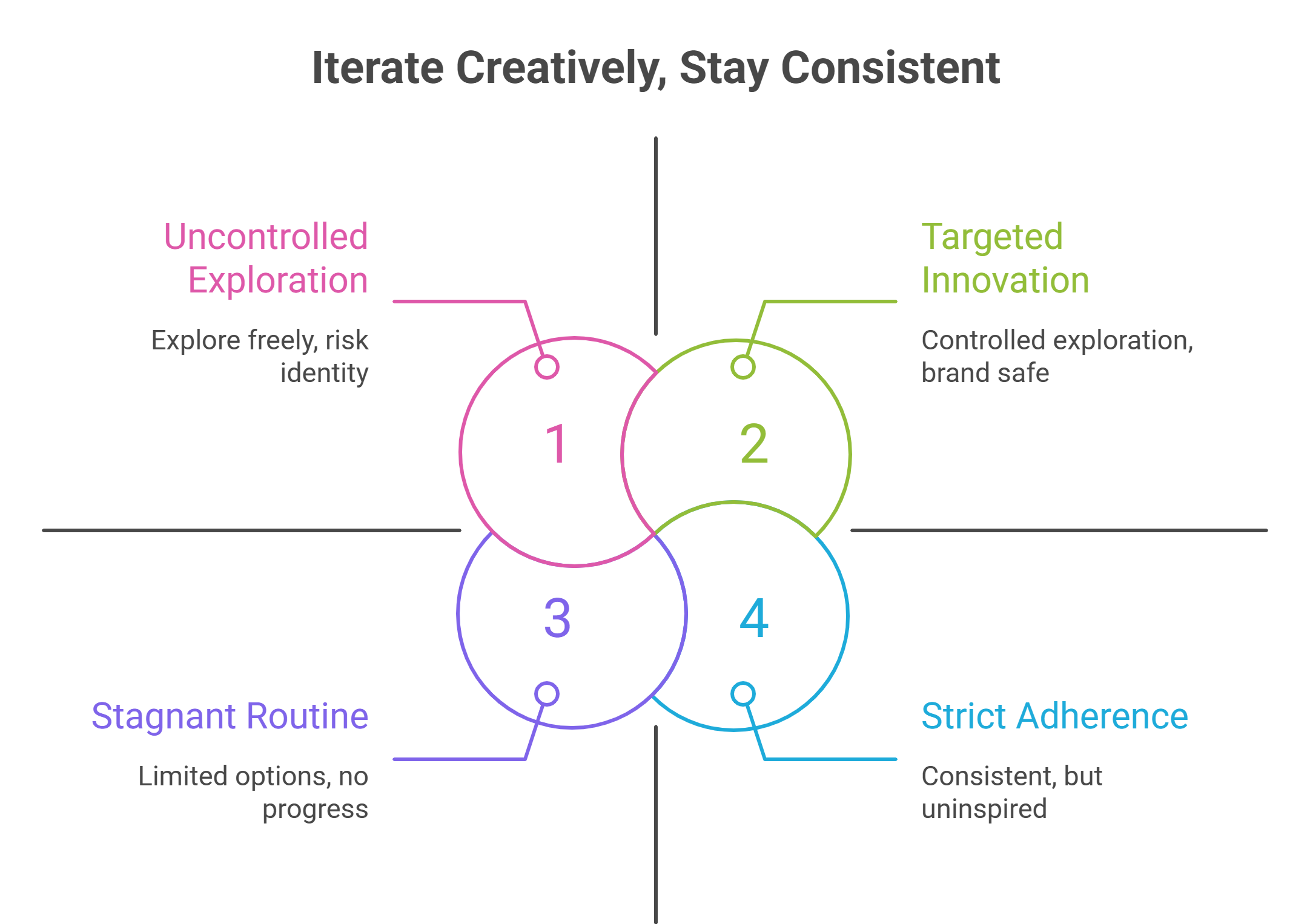
Creative iteration is essential, but for brands it must happen within boundaries. Workflows enable controlled variation by allowing teams to explore alternatives without breaking identity rules.
Instead of regenerating entire images from scratch, workflows can isolate variables. A team might test different compositions while holding color and lighting constant. Or experiment with subject variations while preserving background style.
This targeted iteration speeds up creative decision-making and prevents accidental divergence. Designers spend less time correcting outputs and more time refining intent. The result is image generation that is quick in exploration, good in consistency, and cheap in revision cycles, because the system absorbs complexity instead of the team.
Scaling brand imagery across use cases
Brand image generation rarely stops at a single asset. Campaigns require variations for different platforms, formats and audiences. Localization introduces additional complexity, as visuals must adapt without losing identity.
Workflows make this scaling manageable. Once a base pipeline is defined, it can be reused across contexts. Inputs change, but structure remains the same. This allows brands to generate hundreds or thousands of assets while maintaining coherence.
Cloud-based execution ensures that scaling does not slow teams down. Parallel generation replaces manual batching, and throughput scales with demand rather than infrastructure limitations. Within GMI Studio, orchestration and GPU execution are tightly integrated, enabling high-volume image production without rebuilding infrastructure or sacrificing brand control.
Reproducibility and auditability
For enterprises, reproducibility is not just a creative concern – it is a governance requirement. Teams need to know how an image was generated, which parameters were used, and whether the process can be repeated.
Workflow-driven image generation provides this visibility. Each step is explicit and traceable. Outputs can be linked back to pipeline versions, reference assets and configuration choices.
This auditability builds trust internally and externally. Stakeholders can approve AI-generated imagery knowing it adheres to defined standards. Over time, reproducibility becomes a cost advantage: predictable systems reduce review overhead and minimize expensive rework.
Collaboration between brand and creative teams
Maintaining visual identity with AI is not the responsibility of a single role. Brand managers, designers and technical teams all contribute. Workflows provide a shared language for collaboration.
Brand teams define constraints and references. Designers refine composition and aesthetics. Builders ensure performance and scalability. Changes propagate through the system without requiring everyone to rewrite prompts or reconfigure tools.
This collaborative structure reduces friction and aligns incentives. Creative freedom and brand control coexist rather than compete. Workflow-native environments like GMI Studio make this collaboration explicit, allowing multidisciplinary teams to operate inside a shared visual pipeline instead of disconnected tools.
Moving from experimentation to production
Many brands experiment with AI image generation successfully, then struggle to move into production. The gap is rarely model quality; it is system reliability.
Production use demands predictable outputs, scalable execution and repeatable processes. Workflows bridge this gap by turning experiments into pipelines seeable, versionable and deployable.
Once image generation is embedded into a workflow, it can be integrated into broader content systems. Images flow into marketing platforms, asset libraries or downstream creative tools automatically.
Why infrastructure still matters
While workflows define logic, infrastructure determines execution. Brand image pipelines often require parallel processing, high-resolution outputs and consistent performance under load. Local or ad hoc setups quickly become bottlenecks.
Cloud-based GPU execution ensures workflows run reliably at scale. It enables brands to meet deadlines without compromising quality. Infrastructure becomes an enabler rather than a constraint.
The key is that creators do not need to think about GPUs directly. They design workflows, and the system handles execution.
The future of branded image generation
As generative AI becomes a standard part of creative production, brands that succeed will be those that treat image generation as a system, not a novelty. Visual identity will be encoded into workflows, enforced by structure rather than supervision.
This shift allows brands to scale creativity without losing themselves. AI becomes a collaborator that understands brand language, not a wildcard that must be constantly corrected.
Image generation for brands is no longer about what a model can produce once. It is about what a system can produce consistently, at scale and with intent.
Frequently Asked Questions About Image Generation for Brands and Maintaining Visual Identity with AI
Why is maintaining visual identity important when using AI image generation for brands?
Visual identity builds recognition and trust through consistent colors, lighting, composition and tone. When AI images vary too much in style or structure, that consistency breaks down, which can weaken how audiences recognize and connect with a brand.
Why do prompts alone struggle to keep brand visuals consistent?
Prompts can produce different results even with small wording changes or repeated runs. Because prompts are temporary and brand identity is long-term, relying only on prompts often leads to style drift and inconsistent visual outputs across campaigns.
How do generative workflows help brands maintain visual consistency with AI?
Workflows turn image generation into a structured process rather than a single prompt. Different steps can control layout, color ranges, lighting or other brand rules so every image passes through the same system before being finalized.
How do reference images help guide AI image generation for brands?
Reference images and curated examples can guide the model toward a defined visual style. When these references are built into a workflow, future generations automatically stay closer to the brand’s established look and feel.
How can brands scale AI-generated imagery without losing identity?
Once a workflow is created, the same structure can generate many assets with different inputs. This allows brands to produce large numbers of visuals for campaigns, platforms or regions while preserving the same visual language.
Build AI Without Limits
GMI Cloud helps you architect, deploy, optimize, and scale your AI strategies
FAQ
