Enterprise GPU cloud platforms: what CTOs and ML teams need to know
September 11, 2025
Enterprises are long past the experimentation phase when it comes to AI models: they are no longer proofs of concept – they’re being deployed in production, where uptime, performance and cost predictability matter just as much as accuracy.
Across industries, the shift is profound: retailers personalize shopping experiences in real time, banks detect fraudulent transactions within milliseconds, and healthcare providers use predictive models to improve patient outcomes. These use cases all share a common thread – the demand for infrastructure that can deliver results instantly and reliably.
For CTOs and ML teams, the focus has shifted from if AI can work to how it can be scaled, governed and optimized. That’s where enterprise GPU cloud platforms enter the picture, providing the horsepower to train massive models, serve low-latency inferences, and give organizations the flexibility to grow, adapt and innovate.
However, not all platforms are created equal, and understanding what matters most can mean the difference between smooth deployment and spiraling infrastructure headaches.
Why GPUs are the engine of enterprise AI
At their core, AI workloads are compute-hungry. Training a large language model (LLM) or running millions of real-time inferences per day pushes hardware to the limit, demanding specialized compute. In practice, this means GPUs have become the default choice for enterprise AI workloads. Their parallel architecture and memory bandwidth allow them to process enormous datasets and billions of parameters efficiently, while CPUs continue to play a supporting role – handling preprocessing, orchestration and system-level tasks that complement GPU acceleration.
When delivered through the cloud, GPUs become even more powerful. Teams can scale clusters up during training or traffic surges, then scale back down when demand drops. No massive upfront investment, no idle racks gathering dust – just flexible access to the compute muscle AI requires.
Beyond raw power: what enterprises really need
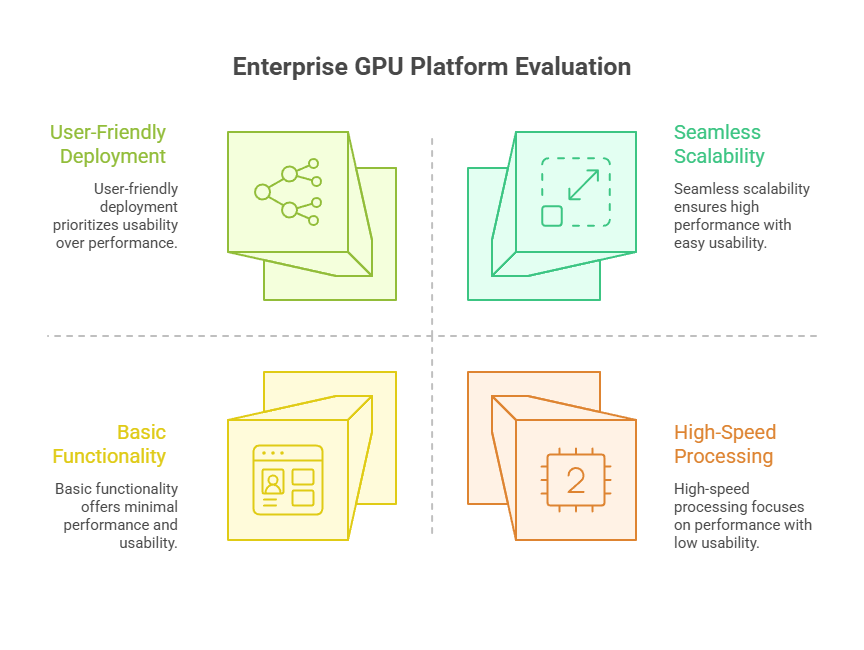
It’s tempting to judge platforms only on how fast their GPUs are. But speed alone doesn’t define success in production. For enterprise adoption, GPU cloud platforms must deliver across several dimensions:
- Elasticity: Can the platform scale seamlessly when traffic doubles overnight?
- Reliability: Will mission-critical applications stay online even during outages or failures?
- Security and compliance: Are data privacy and regulatory requirements baked in, not bolted on?
- Cost control: Do you pay only for what you use, or end up footing the bill for idle GPUs?
- Developer experience: Is it easy for ML teams to deploy, monitor and iterate without wrestling with infrastructure?
The best GPU platforms understand that enterprise AI is about balancing performance with usability, governance and economics.
Architecture that fuels the full AI lifecycle
Training and inference don’t live in silos. Enterprises need GPU platforms that handle the entire AI lifecycle – from preprocessing and distributed training to real-time deployment and monitoring. That means:
- High-throughput storage systems that keep datasets flowing.
- Low-latency interconnects that accelerate multi-GPU training.
- Cluster management tools that simplify resource allocation across teams.
- Geographic distribution that puts inference closer to end users and aligns with data residency laws.
If any of these building blocks are missing, bottlenecks emerge and the system falters. Architecture is the invisible foundation that separates successful AI rollouts from costly failures.
Performance versus cost: finding the sweet spot
Today’s leading GPUs deliver exceptional performance, but that power comes at a premium. Costs vary depending on the hardware generation, configuration and workload, and enterprises often face the challenge of balancing cutting-edge performance with budget constraints. The priority is not simply securing access to top-tier GPUs but optimizing utilization so that every dollar invested translates into measurable business value.
Smarter model design – through quantization, pruning or distillation – can shrink workloads so GPUs handle more requests per second. Intelligent batching keeps cores fully utilized without inflating latency. And observability tools expose underutilized clusters that silently bleed money.
The right platform doesn’t just rent out GPUs – it helps enterprises manage them efficiently, turning raw power into sustainable ROI.
Security and governance in the spotlight
As AI moves into sensitive domains like healthcare, finance and government, security is no longer optional. GPU platforms must enforce role-based access, encrypt data in motion and at rest, and provide audit trails. Compliance with frameworks like GDPR and HIPAA is table stakes.
But governance goes deeper. Enterprises need confidence that multi-tenant clusters are isolated, that workloads can’t interfere, and that data sovereignty rules are respected across borders. These are non-negotiables when AI directly impacts business risk and regulatory exposure.
Making life easier for ML teams
For ML engineers, infrastructure should empower creativity, not slow it down. That’s why developer experience is a crucial differentiator. The best platforms provide streamlined APIs, integrations with popular frameworks, and GPU-aware orchestration systems like Kubernetes.
Equally important is observability – dashboards and metrics that surface latency, throughput and utilization in real time. With the right tooling, ML teams can experiment, debug and optimize faster, cutting down time-to-market and keeping momentum alive.
Multi-cloud, hybrid and the future of flexibility
Enterprises rarely bet everything on a single vendor. Multi-cloud and hybrid strategies give them leverage to optimize costs, avoid lock-in, and improve resilience. For GPU workloads, that means containers, portability and GPU-aware schedulers are must-haves.
The platforms that thrive in the future will be those that make moving workloads across environments seamless – whether from one hyperscaler to another, or from cloud back to on-premises data centers.
The sustainability equation
There’s no ignoring it: large GPU clusters are energy-hungry. With sustainability now on the executive agenda, enterprises are under pressure to cut their carbon footprint. Leading GPU platforms are responding with energy-efficient infrastructure, renewable-powered data centers, and workload optimization features.
For CTOs, choosing a sustainable platform isn’t just good PR – it reduces operating expenses and aligns with corporate ESG commitments. Efficiency is now both a technical and strategic win.
What CTOs and ML teams should prioritize
In the end, choosing a GPU cloud platform is about aligning infrastructure with business needs. CTOs must prioritize architectures that support the full AI lifecycle, deliver elasticity and resilience, and protect sensitive data. ML teams should demand developer-friendly environments that help them iterate faster while keeping costs predictable.
The winners won’t be the platforms that simply offer the fastest GPUs. They’ll be the ones that combine performance with usability, governance and sustainability – helping enterprises bring AI out of the lab and into production at scale.
Looking forward, enterprises that master this alignment will not only gain a technical edge but also a competitive one. The right GPU cloud platform becomes more than infrastructure – it evolves into a strategic asset that accelerates innovation, enables smarter decision-making, and positions organizations to lead in an AI-first future.
Frequently Asked Questions About Enterprise GPU Cloud Platforms
1. Why are GPUs considered essential for enterprise AI workloads?
AI workloads such as training large language models and running millions of inferences daily are extremely compute-intensive. GPUs, with their parallel architecture and high memory bandwidth, handle massive datasets and billions of parameters efficiently. CPUs still play a role in orchestration and preprocessing, but GPUs are the backbone of enterprise-scale AI.
2. What should enterprises look for beyond raw GPU speed?
Performance is important, but it’s not the only factor. Successful enterprise adoption depends on elasticity (scaling on demand), reliability (uptime during failures), security and compliance (GDPR, HIPAA), cost control, and a smooth developer experience. The best GPU platforms balance power with usability and governance.
3. How do GPU cloud platforms support the full AI lifecycle?
A strong platform goes beyond training and inference. It offers high-throughput storage for datasets, low-latency interconnects for distributed training, cluster management tools for efficient resource allocation, and global availability for low-latency inference aligned with data residency laws. These components ensure seamless AI workflows without bottlenecks.
4. How can enterprises balance GPU performance with cost efficiency?
Enterprises can optimize cost by improving model design (quantization, pruning, distillation), using intelligent batching to maximize GPU utilization, and monitoring clusters to prevent underutilization. Cloud pricing models (on-demand, reserved, spot instances) also help tailor spending to workload needs. The goal is to maximize ROI rather than just renting raw compute.
5. What role do security, governance, and sustainability play?
Security is a non-negotiable for industries like finance and healthcare. Platforms must provide encryption, access controls, compliance certifications, and workload isolation in multi-tenant environments. At the same time, sustainability is rising in importance: enterprises expect energy-efficient infrastructure, renewable-powered data centers, and optimization tools that reduce both carbon footprint and operating expenses.
Build AI Without Limits
GMI Cloud helps you architect, deploy, optimize, and scale your AI strategies
