Understanding the distinction between AI models and systems is crucial for making informed implementation decisions that align with your organization's needs and resources.
- AI models are focused tools - They perform specific tasks like spam filtering or defect detection, while AI systems integrate multiple models with infrastructure to deliver complete solutions.
- Most businesses should implement AI systems, not standalone models - Systems keep humans in the loop for decision-making while leveraging AI for data processing and recommendations.
- Start with recommendation systems before full automation - Build trust by having AI suggest actions while humans make final decisions, then gradually increase autonomy as reliability is proven.
- Budget for significant costs - Simple AI models start around $5,000, while complex systems range from $50,000 to over $500,000, with computing costs rising 89% through 2025.
- Choose deployment based on control needs - Use SaaS for quick adoption, MaaS for API flexibility, or self-hosted solutions when data control is paramount.
The key is matching your AI approach to your specific use case, budget, and desired level of human oversight rather than pursuing the most advanced option available.
Artificial intelligence grows in use in any discipline, from education to business. Yet many find it confusing to understand the AI system definition versus individual AI models. People often use these terms interchangeably, but they represent different concepts. AI models are the core components that perform specific tasks. AI systems integrate these models into complete and functional solutions. You need to learn what an AI model is and understand the AI model definition to make informed decisions about implementing AI in your organization.
In this piece, we'll walk you through what defines AI models and AI systems, the key differences between them, and how to determine which approach best fits your needs.
What is an AI model
Core definition and purpose
An AI model is a program trained on a dataset to recognize patterns or make decisions without further human intervention. What an AI model comes down to is applying algorithms to relevant data inputs to achieve specific tasks or outputs they've been programmed for. The ai model definition centers on autonomous decision-making or prediction capabilities rather than simulating human intelligence.
The relationship between algorithms and models clarifies the ai system definition. An algorithm provides step-by-step instructions that tell a system how to interpret data and generate outputs. An AI model applies those instructions to massive amounts of data, learns from it, and uses uncovered patterns to make predictions or decisions. Algorithms are the mathematical logic. AI models are the trained output after processing data.
Types of AI models
Machine learning models fall into three broad categories. Supervised learning uses labeled datasets where the model trains to predict correct outputs for inputs. This applies to tasks requiring accuracy against external ground truth such as classification or regression. Unsupervised learning trains models to identify intrinsic patterns in unlabeled data without assumed ground truth, useful for clustering and finding hidden correlations. Reinforcement learning trains algorithms through reward and punishment systems, where agents take actions to maximize rewards.
Models also differ by approach. Generative algorithms model data distribution to predict joint probability and enable them to generate new outputs like text or images. Discriminative algorithms model decision boundaries between data classes to predict conditional probability and require less computing power.
How AI models are trained
Training involves feeding curated data to algorithms and helps systems refine themselves to produce accurate responses. Models adjust parameters including weights and biases in their mathematical functions to minimize a loss function that measures output error. Supervised learning requires thoughtfully labeled training data by data scientists to optimize results. Models like GPT-3 and BLOOM have over 175 billion parameters and require enormous datasets for training.
Foundation models are pretrained on large-scale datasets to learn general features, then fine-tuned for specific tasks. This approach saves resources compared to training from scratch.
AI model examples in practice
Neural networks power applications from voice assistants to self-driving cars and use interconnected nodes across multiple layers to process data. Linear regression models predict continuous values like sales revenue projections. Logistic regression handles binary classification tasks such as fraud detection. Decision trees and random forests break down complex decisions into nodes representing potential classifications.
What is an AI system
Definition and scope
An AI system represents a complete, functional solution designed to operate with autonomy and influence physical or virtual environments. The ai system definition includes machine-based systems that infer from inputs how to generate predictions, content, recommendations, or decisions. Standalone models differ from systems. Systems integrate one or more models with supporting infrastructure to perform tasks that affect ground outcomes.
The European AI Act identifies seven elements qualifying a system as AI: machine-based operation, explicit or implicit objectives, varying levels of autonomy, potential adaptiveness after deployment, knowing how to generate predictions or decisions, capacity to influence environments, and inference capabilities from received inputs.
Everything in an AI system
Functional systems require multiple specialized components working together. Foundational models provide base language understanding and generation capabilities. They process inputs to produce outputs. Orchestration frameworks manage data retrieval and ensure models access correct information and include necessary variables. Vector embeddings transform text into numerical representations for semantic searches, while vector databases store these embeddings for quick retrieval.
Infrastructure includes compute resources, storage solutions, and high-performance hardware for processing complex computations. Monitoring tools track decisions, state changes, and performance metrics. They create transparent histories for compliance. User interfaces enable human interaction through chatbots or web applications.
In modern AI architectures, infrastructure is no longer just a supporting layer but a critical part of system performance. With GMI Cloud, teams can run models in serverless environments or scale to dedicated GPU clusters depending on workload requirements. This flexibility allows organizations to move from experimentation to production without rebuilding their infrastructure stack.
How AI systems integrate models
Integration embeds AI capabilities into existing workflows through data pipelines that total information from various sources. The process involves centralizing data in adaptable environments and applying machine learning techniques to transform raw data into practical insights. Algorithms deploy through APIs or edge devices. Modern architectures use patterns like retrieval augmented generation and connect organizational data sources while preserving governance.
In practice, deploying these architectures requires infrastructure that can handle variable workloads and high-performance inference. AI platforms such as GMI Cloud support this by offering scalable deployment options, allowing teams to serve models via APIs, manage inference workloads efficiently, and maintain performance across different regions and use cases.
Ground AI system examples
AWS SageMaker integrates AI components with cloud infrastructure and supports end-to-end workflows from data architecture to model deployment. Azure combines distributed systems with cloud infrastructure for adaptable model deployment across enterprise services. Customer service applications use conversational AI with natural language processing and sentiment analysis for interactions that happen in the moment.
Key differences between AI tools and AI systems
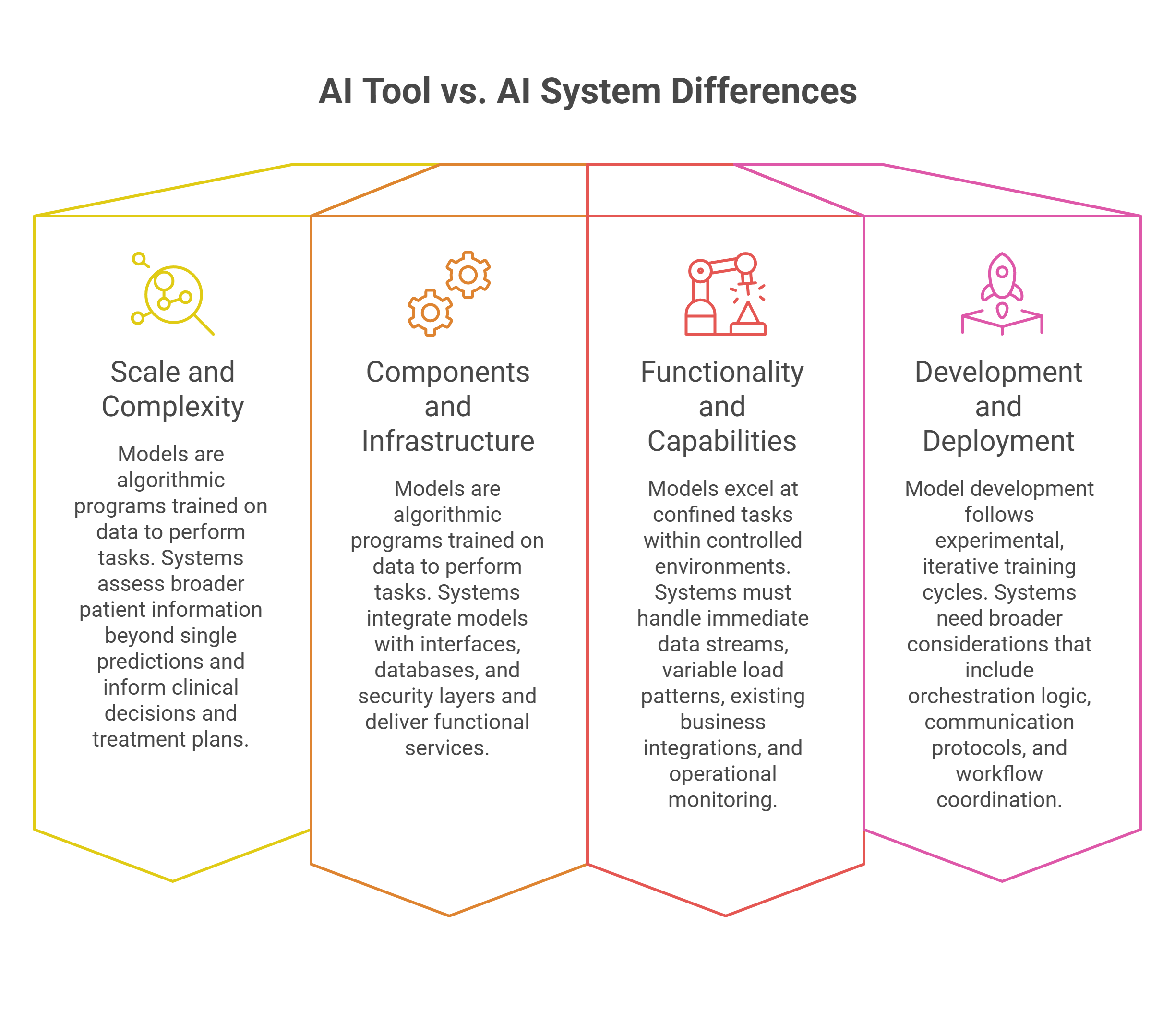
Scale and complexity
Understanding scope helps distinguish between the ai model definition and ai system definition. An AI model involves input data, a pattern-matching algorithm, and output classification. A radiology scan might feed into a model predicting COVID-19 presence. Systems assess broader patient information beyond single predictions and inform clinical decisions and treatment plans.
Components and infrastructure
Infrastructure needs make what is an AI model clearer. Models are algorithmic programs trained on data to perform tasks. Models cannot function in isolation, though, until implemented with supporting hardware or software. Systems integrate models with interfaces, databases, and security layers and deliver functional services. This integration may include orchestration frameworks, vector databases, monitoring solutions, and user interfaces.
Functionality and capabilities
Models excel at confined tasks within controlled environments. Systems must handle immediate data streams, variable load patterns, existing business integrations, and operational monitoring. Performance metrics like accuracy scores calculate on models with ease but reveal little about system utility in practice. Contextual parameters, user interface design, and workflow integration determine whether systems succeed or fail.
Development and deployment
Model development follows experimental, iterative training cycles. Systems need broader considerations that include orchestration logic, communication protocols, and workflow coordination. Models achieve 87% accuracy on isolated tasks. Systems demand validation across every element, from data pipelines to end-user experience. Production deployment introduces challenges like model drift monitoring, security surfaces, and cost structures that models alone never encounter.
Choosing between AI tools and AI systems for your needs
When to use AI models
Stand-alone models work best for well-laid-out, narrow tasks where you need specific predictions or classifications. Think about filtering spam emails or detecting manufacturing defects. Traditional AI models are often enough for these focused applications that don't require the overhead of full system architecture.
When to implement AI systems
Most businesses should focus on implementing AI systems rather than autonomous solutions. This approach keeps humans in the loop. Systems crunch data and suggest actions, but people make final calls. It's a pragmatic middle ground that delivers AI benefits without surrendering control. Start by building a system that provides recommendations. As your team confirms outputs, you establish reliability and trust. Therefore, you can increase autonomy until the system handles well-laid-out tasks independently.
Cost and resource considerations
Computing costs are climbing 89% between 2023 and 2025. Seventy percent of executives cite generative AI as the critical driver. Every executive surveyed reported canceling or postponing at least one generative AI initiative due to cost concerns. Simple AI models start around $5,000, while complex solutions scale from $50,000 to over $500,000. Choose SaaS deployment for fast adoption with minimal setup. MaaS offers API-based flexibility, and self-hosted options work best at the time data control is paramount.
Conclusion
Understanding the difference between AI models and AI systems helps you make smarter implementation decisions. Models handle specific tasks, while systems deliver complete solutions that integrate into real-world workflows.
As organizations move from isolated experiments to production-ready AI systems, infrastructure becomes a defining factor. The ability to run multiple models, manage inference workloads, and scale efficiently is what turns a working model into a reliable system.
GMI Cloud helps bridge this gap by combining flexible infrastructure with production-ready deployment options. This makes it possible to build AI systems that are not only functional, but scalable, cost-efficient, and ready for real-world use.
FAQs
What distinguishes AI tools from AI systems in terms of functionality?
AI tools are designed to handle specific, well-defined tasks like spam filtering or defect detection, requiring human input for prompts and decisions. AI systems, on the other hand, integrate multiple models with supporting infrastructureâincluding databases, interfaces, and orchestration frameworksâto deliver complete, autonomous solutions that can manage entire workflows and real-world outcomes.
Is ChatGPT considered an AI model or an AI system?
ChatGPT functions as an AI system. It's a generative AI chatbot powered by OpenAI's GPT family of models, using natural language processing to conduct conversations and generate various types of content. The system integrates the underlying model with user interfaces, data processing capabilities, and supporting infrastructure to deliver a complete conversational experience.
When should a business choose AI models versus implementing full AI systems?
Standalone AI models work best for narrow, well-defined tasks with specific predictions or classifications, such as sales forecasting or manufacturing defect detection. However, most businesses benefit from implementing AI systems that keep humans in the loopâwhere AI processes data and provides recommendations while people make final decisions. This approach delivers AI benefits without surrendering control and allows for gradual automation as trust builds.
What are the main cost considerations when implementing AI solutions?
AI implementation costs vary significantly based on complexity. Simple AI models typically start around $5,000, while complex systems can range from $50,000 to over $500,000. Computing costs are rising sharply, with an 89% increase expected between 2023 and 2025, primarily driven by generative AI adoption. Organizations should choose deployment optionsâSaaS for quick adoption, MaaS for API flexibility, or self-hosted for data controlâbased on their budget and requirements.
What essential components make up a functional AI system?
A functional AI system requires multiple integrated components working together: foundational models for core processing capabilities, orchestration frameworks to manage data retrieval, vector databases for storing and retrieving information, computing infrastructure for processing, monitoring tools for tracking performance and compliance, and user interfaces for human interaction. These components work together to transform AI models into complete, deployable solutions.
Build AI Without Limits
GMI Cloud helps you architect, deploy, optimize, and scale your AI strategies
FAQ
AI tools are designed to handle specific, well-defined tasks like spam filtering or defect detection, requiring human input for prompts and decisions. AI systems, on the other hand, integrate multiple models with supporting infrastructureâincluding databases, interfaces, and orchestration frameworksâto deliver complete, autonomous solutions that can manage entire workflows and real-world outcomes.
