The rise of AI workflow orchestration platforms in 2026
April 07, 2026
AI workflow orchestration platforms are transforming AI from isolated prompt-based usage into structured production systems by enabling teams to connect models, manage workflows, and scale output reliably across complex, multimodal pipelines.
Key things to know:
- Why AI adoption is shifting from model performance to workflow orchestration
- How orchestration platforms solve the layer above generation where real production happens
- Why connecting multiple steps, models, and tools is now essential for scalable AI systems
- How orchestration enables sequencing, branching, retries, and context management
- Why modern AI workflows require coordination across text, image, video, and automation tasks
- How orchestration turns AI usage into a structured operating system rather than isolated sessions
- Why 2026 marks a shift toward production-ready, repeatable AI workflows
- How collaboration across teams drives the need for visual, reusable workflow systems
- Why orchestration improves speed, consistency, and cost efficiency at the same time
- How reproducibility and workflow reuse become critical for long-term scalability
- Why infrastructure, compute, and performance are part of workflow design
- How orchestration platforms enable teams to move from experimentation to real production systems
AI adoption in 2026 is exposing a clear divide between teams that can generate something impressive and teams that can run production reliably. A prompt can produce an image, a script or a clip. That is not the hard part anymore. The hard part is connecting generation steps, managing context, handling retries, coordinating different models, and producing output that holds up under real deadlines and real volume.
That is why workflow orchestration platforms are rising so quickly. They solve the layer above the model: the layer where production actually happens. Major platforms across the market are moving in this direction, combining models, tools, infrastructure and execution logic rather than treating generation as a one-step interaction.
This shift matters because modern AI workflows are more complex. One pipeline may include text, images, video, transcription, evaluation, human review and downstream delivery. At that point, the challenge is no longer model access, but orchestration: sequencing steps, managing branches, preserving context, and keeping the process reproducible. AI production has moved beyond isolated prompting. That is why orchestration platforms are rising.
Why orchestration is becoming the new AI layer
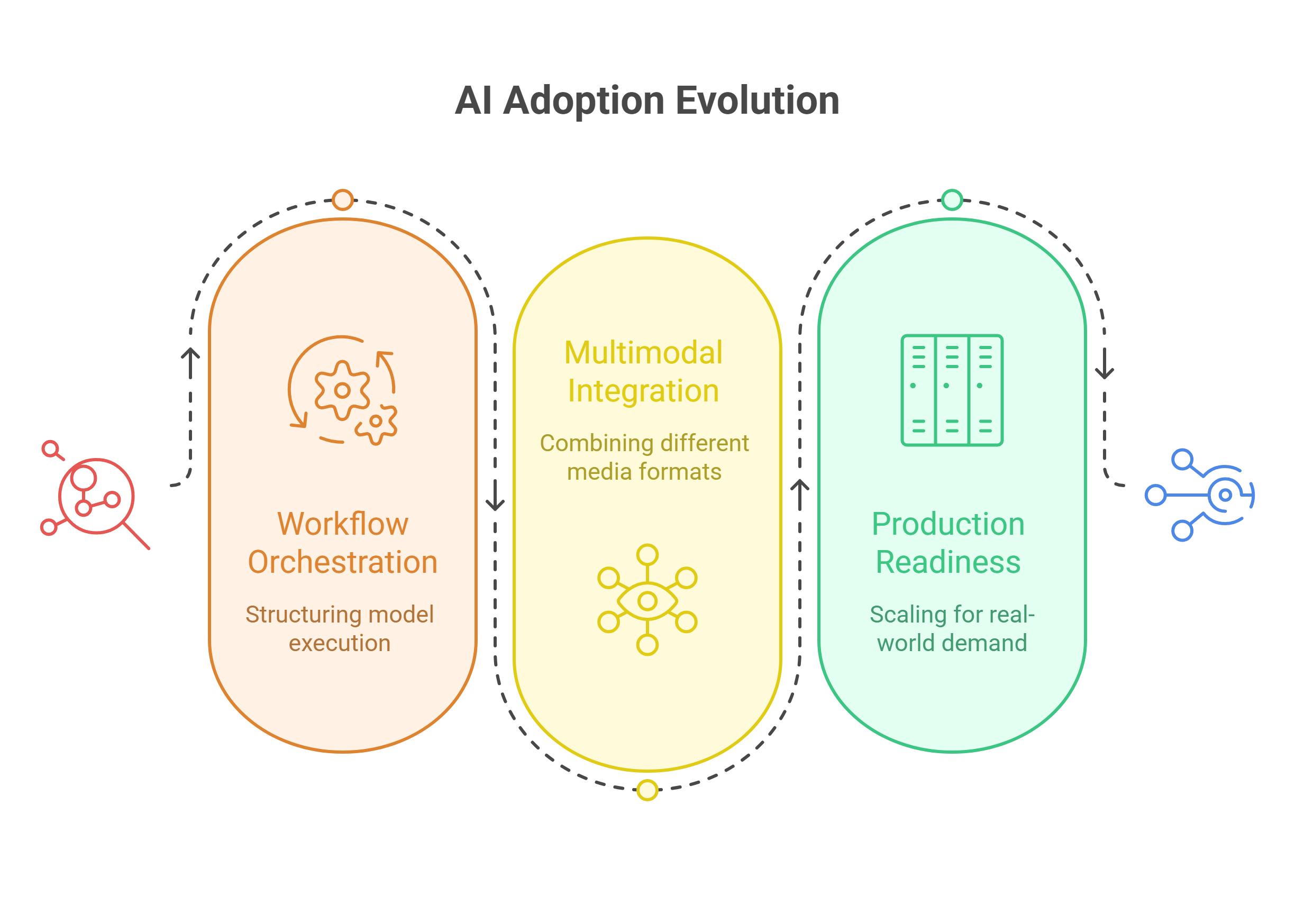
The first phase of generative AI adoption was model-centric. Teams asked which model was best, which one was fastest, and which one produced the strongest outputs. Those questions still matter, but they are no longer enough. In production, the model is only one component inside a broader system. As teams generate more content, automate more internal processes, and combine multiple forms of media, they need a way to organize execution across all of it.
This is why orchestration is becoming the new layer of value. A workflow orchestration platform does not just provide access to models. It provides a structured environment for designing how models, tools and decision points work together. That includes sequencing, branching, state management, reusable workflow logic and production controls. In other words, it turns AI use into an operating system rather than a collection of sessions.
That change is especially visible in multimodal production. If one team is building a campaign across text, image and video, or another is combining agents, data and automation, the old pattern of opening separate tools and manually stitching results together becomes a drag on speed and consistency. Orchestration platforms reduce that friction by giving teams a system where the workflow itself becomes the core asset. That is one reason unified AI platforms and agent engines are expanding so quickly across the market.
Why 2026 is the year this category matters
The rise of orchestration platforms is not happening by accident. It is happening because the surrounding environment has changed. Models are getting better across text, image, audio and video. Teams are no longer experimenting with one output at a time, but trying to build repeatable pipelines. At the same time, expectations have changed. Businesses want faster production, more variations, lower costs and more reliable output. Those expectations cannot be met with prompting alone.
Another reason is that production workflows are becoming more collaborative. They involve creators, marketers, builders and operations teams, not just one technical operator. That’s why a workflow must be understandable, reusable and adjustable across roles. That is pushing the market toward more visual, more controllable and more production-ready orchestration systems rather than ad hoc scripts or hidden prompt chains.
There is also a business reason behind the rise. Orchestration helps teams get closer to the quick, good, cheap triangle that creative and production teams care about most. When workflows are structured properly, repeatable steps can be automated, context can be preserved, and successful logic can be reused across projects. That improves speed, consistency and cost efficiency at the same time. The model still matters, but orchestration is what makes those gains durable.
This is where GMI Studio fits naturally into the 2026 shift. GMI Studio is a visual, node-based platform for production AI workflows across video, image and agent use cases. That makes it more than a place to run a model. It is designed around the reality that teams need to connect models, logic and infrastructure inside one production system. GMI Studio embodies the idea of workflows designed for production, not isolated prompts.
What teams actually need from orchestration platforms
The rise of this category also reflects a clearer understanding of what teams need from AI systems. First, they need control. A good orchestration platform should let teams define stages, rerun specific steps, manage branching paths, and preserve state across the workflow. Without that, every output feels fragile.
Second, they need reproducibility. If a workflow works once but cannot be repeated, reused or improved, it does not really scale. This is one of the biggest gaps between demos and production. A production workflow needs to be inspectable, versionable and reliable enough that a team can build on it over time.
Third, they need multimodal flexibility. Creative and operational workflows are increasingly crossing formats. The same pipeline may touch text, images, voice, video, metadata and agent actions. A platform built for only one modality will struggle as these use cases become more connected.
Fourth, they need infrastructure awareness. Orchestration is not just a UX problem. It also depends on compute, throughput, latency and the ability to scale under real demand. This is why orchestration platforms tied closely to GPU infrastructure have an advantage in production settings. They do not just visualize the workflow. They support actually running it at the level teams need.
GMI Studio is a production-ready workflow platform, combined with dedicated GPU infrastructure and model customization, and that’s why it makes sense in a market where orchestration is no longer abstract.
The category is rising because prompting is not enough
What is happening in 2026 is not the disappearance of prompting. Prompts still matter and they remain an important input into the system. But they are no longer where serious production begins and ends. The real work now sits in the layer around the prompt: the workflow logic, the sequencing, the context handling, the evaluation and the infrastructure that supports it all.
That is why AI workflow orchestration platforms are rising. They reflect a more mature understanding of how AI creates value. Value does not come from a one-off output. It comes from a system that can generate, adapt, check and scale output repeatedly. As teams move beyond experimentation, they need platforms built around that reality.
For creators, builders and enterprises alike, this is where the market is heading. The next phase of AI adoption will be defined by more than just which models are available. It will be shaped by which platforms make those models usable inside real workflows. GMI Studio is part of the shift because it treats workflow design as the center of production, not as an afterthought around a model. In 2026, that is increasingly what serious AI platforms need to do.
Build AI Without Limits
GMI Cloud helps you architect, deploy, optimize, and scale your AI strategies
FAQ
