The value of orchestration: Why 2026 will be defined by AI workflows, not single models
March 25, 2026
AI orchestration transforms generative workflows from isolated model usage into coordinated systems where multiple specialized models work together to deliver scalable, efficient and high-quality outputs.
Key things to know:
- Why relying on a single model no longer meets the demands of modern, multi-stage AI workflows
- How model specialization improves performance across tasks like generation, refinement, and synchronization
- What AI orchestration is and how it coordinates multiple models into a unified system
- Why orchestration enables parallel processing, reducing latency and increasing production speed
- How routing tasks to the most suitable model improves both quality and cost efficiency
- The role of orchestration in maintaining consistency across complex, multi-step workflows
- Why multimodal creation (image, video, audio, text) makes orchestration essential rather than optional
- How orchestration transforms AI from a set of tools into a scalable, production-ready system
- Why pipelines replace prompts as the core unit of AI creation in modern workflows
- How orchestration aligns creative flexibility with operational reliability for long-term scalability
The way teams build with AI is changing again – and this shift is more fundamental than another model release or benchmark milestone. The next evolution of AI creation is not about finding the one model that does everything best. It’s about orchestrating many specialized models so they work together as a system.
This is why orchestration is becoming the defining capability of AI workflows in 2026. As generative use cases grow more complex across image, video, audio and multimodal creation, relying on a single, generic model no longer makes sense. No model can be optimal at every task, and forcing one to try only creates inefficiency, inconsistency and wasted compute.
The future belongs to coordinated AI systems – and orchestration is the layer that makes them possible.
Why the “one model does everything” approach is breaking down
Early generative AI workflows were simple. One prompt, one model, one output. That approach worked when expectations were low and use cases were narrow, but today it collapses under real-world demands.
Modern AI creation involves multiple stages: generating concepts, refining structure, adding detail, enforcing style consistency, synchronizing modalities, and producing final assets at scale. Each of these stages benefits from different model characteristics. Some require speed. Others demand precision. Others prioritize cost efficiency.
Trying to push all of this through a single model leads to tradeoffs everywhere. Outputs become inconsistent. Latency grows. Costs spike. Iteration slows.
The problem is not the models. It’s the architecture.
Specialization beats generalization in production
AI models are becoming increasingly specialized – and that’s a good thing. Some models excel at composition. Others at realism. Others at language understanding, audio synthesis, motion coherence or embeddings.
In production workflows, specialization enables better results with fewer compromises. But specialization only delivers value if those models can work together smoothly.
This is where orchestration becomes essential.
Orchestration allows teams to route each task to the model best suited for it, sequence outputs intelligently, and synchronize results across modalities. Instead of forcing one model to do everything poorly, orchestration lets many models do what they do best – together.
Orchestration turns AI from a tool into a system
Without orchestration, AI remains a collection of tools. With orchestration, it becomes a system.
A system can coordinate steps, preserve context, handle branching logic, retry intelligently, and evolve over time. It can support experimentation without breaking production. It can absorb new models without requiring rewrites.
This shift mirrors how other creative technologies matured. Photography didn’t scale because cameras improved alone – it scaled because workflows emerged: editing pipelines, asset management, versioning, distribution systems.
AI creation is following the same path.
The business impact: velocity without compromise
From a business perspective, orchestration solves the problem of efficient velocity.
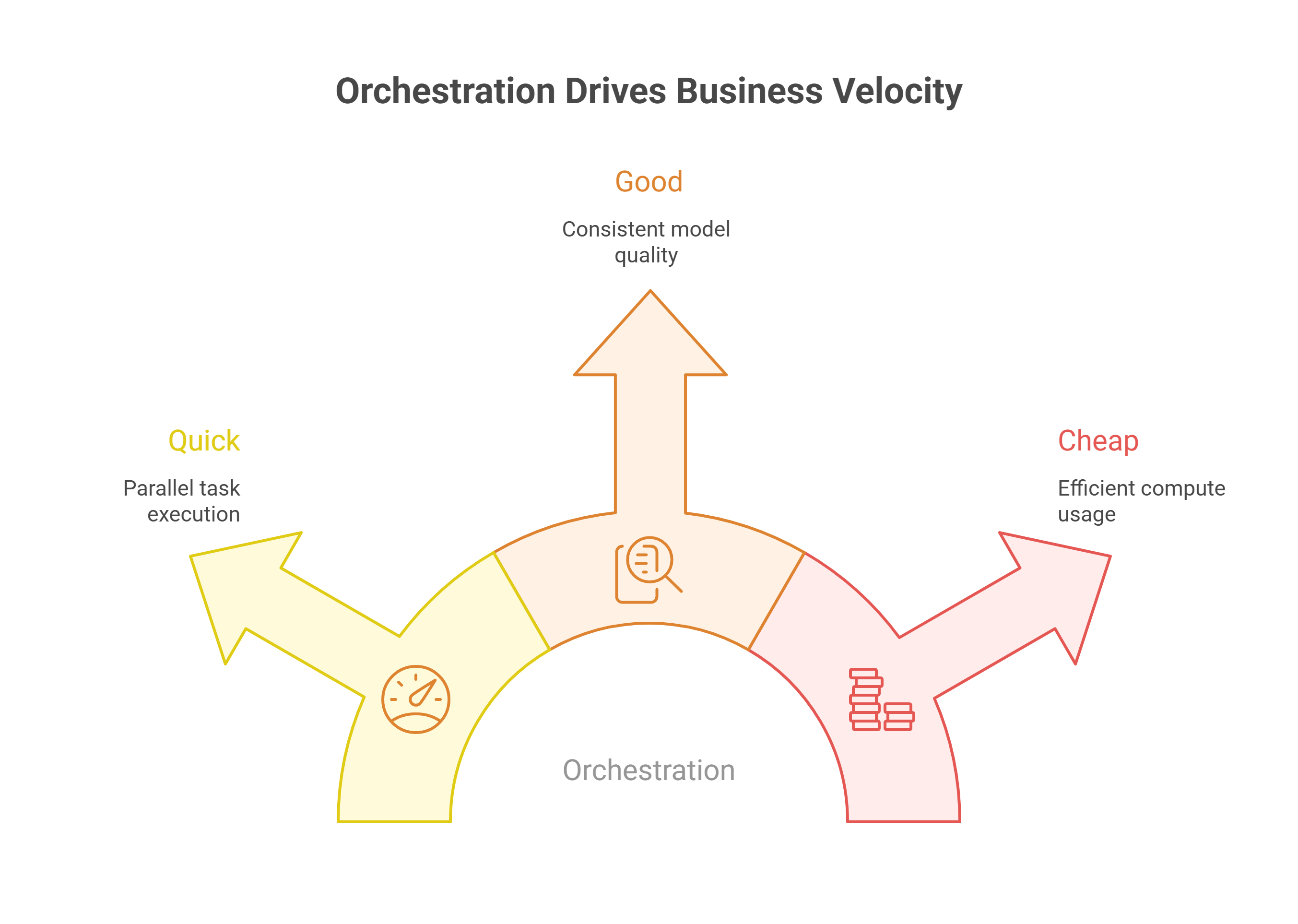
The old triangle said you could have work that was quick, good or cheap – but not all three. AI workflows are collapsing that tradeoff, and orchestration is the reason.
- Quick, because tasks run in parallel instead of sequentially
- Good, because specialized models deliver consistent quality
- Cheap, because compute is used efficiently and outputs are reusable
This is not theoretical. Teams that orchestrate workflows spend less time waiting, less time redoing work, and less time paying for wasted generation.
Why orchestration matters even more for multimodal creation
Multimodal AI workflows – combining image, video, audio and text – make orchestration unavoidable.
Each modality introduces its own constraints. Timing matters. Context matters. Consistency matters. A single misalignment can break the entire output.
Orchestration ensures that models stay in sync. It manages dependencies. It coordinates retries. It preserves creative intent across stages.
Without orchestration, multimodal generation becomes fragile. With it, it becomes scalable.
From prompts to pipelines
The most important mental shift for creators and builders is moving away from prompts and toward pipelines.
Prompts are ephemeral. Pipelines are durable. A pipeline captures logic. It documents creative decisions. It makes outputs reproducible. It enables collaboration. It turns experimentation into production.
Orchestration is what makes pipelines possible at scale.
Orchestration aligns creative intent with operational reality
As AI systems mature, the gap between creative intent and operational execution becomes one of the biggest sources of friction. Creators want flexibility, experimentation, and expressive control. Production systems demand reliability, predictability and cost discipline. Orchestration is the mechanism that reconciles these needs.
By explicitly defining how models interact, when they run, and how outputs flow between stages, orchestration transforms creative logic into something operationally stable. This alignment is what allows AI workflows to move out of isolated experiments and into sustained production use – without forcing creators to sacrifice speed or control to meet enterprise requirements.
Why 2026 is the turning point
2024 was defined by model breakthroughs. 2025 was defined by inference optimization. 2026 is shaping up to be defined by creation – and creation demands orchestration.
As AI becomes embedded in real production workflows, the value shifts away from raw capability and toward reliability, repeatability and speed. Orchestration is the layer that connects these requirements.
This is also why infrastructure alone is no longer enough. GPUs matter. Models matter. But without orchestration, they remain disconnected pieces.
Where GMI Studio fits
GMI Cloud built GMI Studio specifically to address this shift. GMI Studio is designed as a visual, workflow-first platform where orchestration is the core abstraction. Instead of asking users to stitch models together manually or write glue code, it allows creators and teams to design synchronized AI workflows visually.
Multiple specialized models can be combined into a single, repeatable pipeline. Changes propagate cleanly. Outputs stay consistent. Workflows scale from individual creators to enterprise production without breaking.
GMI Studio makes orchestration accessible not just for engineers, but for anyone building with AI.
Orchestration as creative leverage
The most powerful aspect of orchestration is not technical, but creative.
When creators don’t have to fight tools, they experiment more. When systems are reliable, teams push boundaries. When workflows are reusable, creativity compounds. Because of this, orchestration amplifies creativity instead of constraining it.
The next evolution of building with AI
The future of AI creation will not be defined by a single breakthrough model. It will be defined by how well teams can coordinate many models into cohesive systems.
Orchestration is the missing layer that turns AI from a collection of impressive demos into a production-ready creative engine.
That’s why 2026 will be remembered not as the year of another model – but as the year orchestration became the foundation of building with AI.
Build AI Without Limits
GMI Cloud helps you architect, deploy, optimize, and scale your AI strategies
FAQ
