No-code generative AI workflows transform fragmented, prompt-based creation into structured systems that enable creators to build, scale and reproduce content without technical complexity.
Key things to know:
- Why prompt-based creation breaks down when projects require iteration, consistency and scale
- What generative workflows are and how they capture the full creation process, not just outputs
- How visual, no-code workflows replace scripting with intuitive, block-based systems
- Why workflows allow creators to automate variations, reuse styles and maintain consistency across assets
- How structured pipelines improve both speed and quality by eliminating manual repetition
- The importance of reproducibility for turning creative experiments into reliable production systems
- How workflows decouple effort from output, enabling scalable content generation with minimal additional work
- Why visual workflows enhance collaboration by making creative processes transparent and shareable
- How multimodal workflows integrate image, video and audio into a unified creation system
- Why workflow-first platforms remove infrastructure barriers, allowing creators to focus purely on creative decisions
For many creators, generative AI has felt both exciting and frustrating. The models are powerful. The results can be stunning. But turning those results into something usable, repeatable and scalable often requires technical setup, scripting or local tooling that pulls creators away from what they actually want to do: create.
The next phase of generative AI isn’t about better prompts or more models. It’s about workflows – systems that let creators move from idea to output without becoming engineers. When workflows are visual, structured and reproducible, creators gain access to the full power of AI without needing to write code.
Why prompts alone don’t scale
Prompting is a great starting point, but it breaks down quickly in real production scenarios. A single prompt might generate a great image or clip, but production rarely stops at one output. Creators iterate, refine and regenerate. They adapt assets for new formats, languages or platforms.
Without workflows, every change means starting over. Prompts are copied, tweaked and reapplied manually. Outputs drift in quality. Consistency becomes subjective. What felt fast at the beginning becomes slow and error-prone at scale.
Workflows solve this by turning creative intent into a structured process rather than a series of one-off interactions.
What a generative workflow actually is
A generative AI workflow is a sequence of connected steps that transform inputs into outputs in a predictable way. Each step has a purpose, and the connections between steps preserve context.
For creators, this might mean:
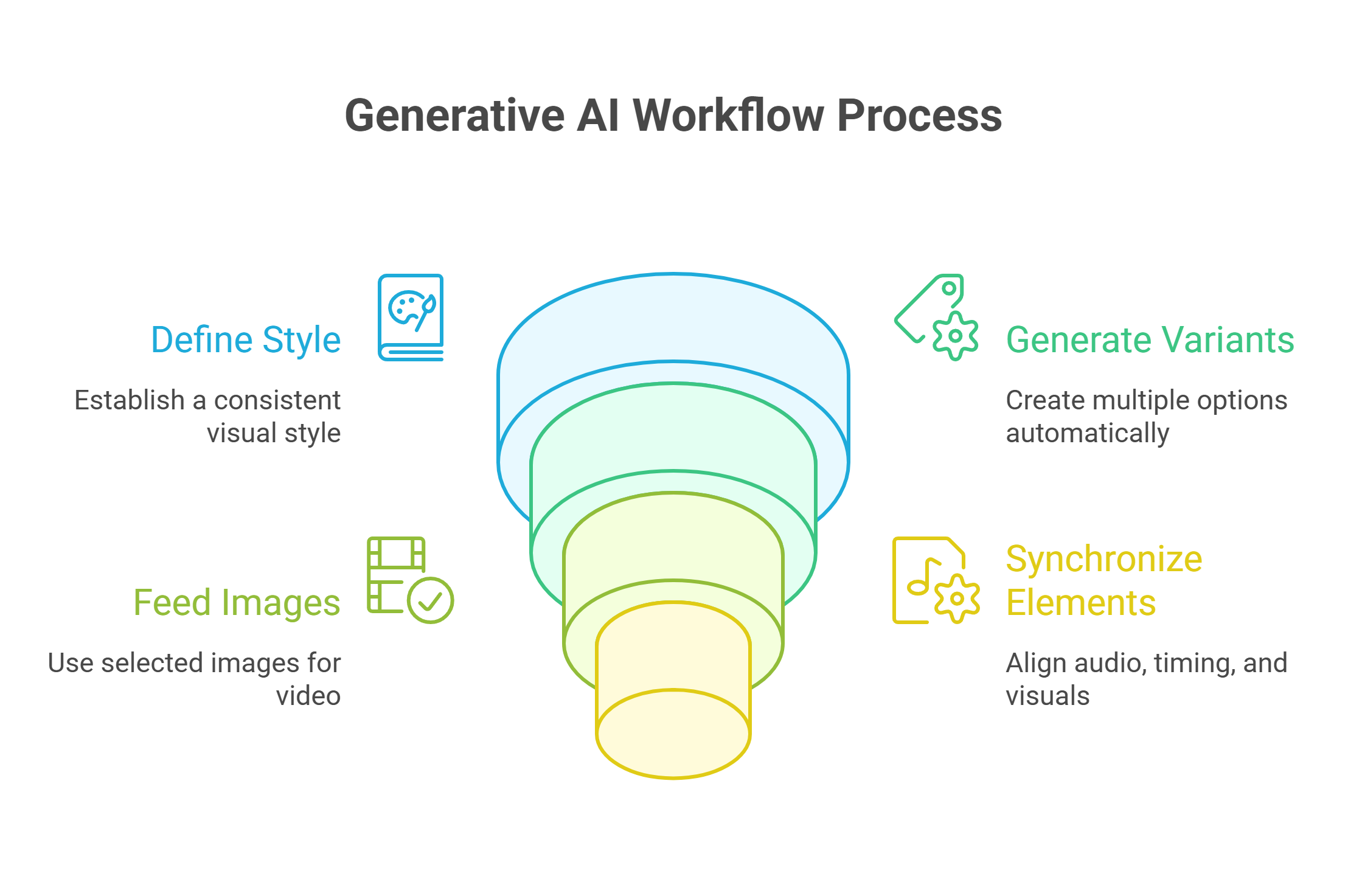
- Defining a base visual style once and reusing it across generations
- Generating multiple variants automatically instead of manually re-prompting
- Feeding selected images into video generation pipelines
- Synchronizing audio, timing and visuals without manual alignment
The key is that the workflow captures how something is made, not just what is generated.
Visual workflows replace scripting
Traditionally, building these pipelines required code. Scripts handled branching logic, retries, parameter tuning and orchestration. That barrier excluded many creators.
Visual workflow platforms change this dynamic. Instead of writing code, creators connect blocks. Each block performs a specific function – image generation, transformation, filtering, audio synthesis or video assembly. The logic is visible. The flow is intuitive.
This makes complex pipelines accessible without sacrificing power. Creators can build sophisticated systems simply by arranging components visually.
Faster creation without sacrificing quality
One of the biggest myths around no-code tools is that they trade depth for simplicity. In generative AI workflows, the opposite is often true.
By automating repetitive steps, workflows increase speed while improving quality. Instead of rushing to recreate assets manually, creators let the system handle regeneration consistently. Style, tone, pacing and structure remain stable even as content evolves.
This is where the old “quick or good” tradeoff starts to disappear. Structured workflows deliver both.
Reproducibility turns experiments into products
Creators often experiment freely, but enterprises and professional teams need reproducibility. A workflow that works once must work again – tomorrow, next month or next year.
Visual workflows capture every decision explicitly. Parameters are visible. Steps are ordered. Outputs can be recreated reliably.
This matters for brand identity, compliance and long-term projects. When creators can reproduce results without guesswork, generative AI becomes a dependable production tool rather than a novelty.
Scaling creativity without scaling effort
Without workflows, scaling output usually means scaling effort. More assets require more manual work. More variations require more prompting.
Workflows decouple effort from output. A single pipeline can produce dozens or hundreds of assets with minimal incremental cost. Changes propagate automatically. Variants generate in parallel.
This is where generative AI becomes cheap in the most meaningful sense: the cost per usable output drops dramatically while quality remains consistent.
Why workflows unlock collaboration, not just automation
One often overlooked benefit of no-code generative workflows is how they change collaboration between creative teams. Without workflows, AI generation tends to live in silos – one designer owns a prompt, another tweaks it, and knowledge is lost as soon as the output is exported. Workflows make the creative process shareable.
A visual pipeline becomes a common language between designers, video editors, audio specialists and producers. Each contributor can understand how assets are created, where changes can be made, and how variations propagate through the system. This reduces handoff friction and eliminates the need to explain creative intent repeatedly.
More importantly, workflows preserve institutional knowledge. Instead of living in someone’s head or browser history, creative logic becomes an asset the entire team can reuse, refine and build on. That’s how AI creation scales across people – not just machines.
Multimodal creation without complexity
Modern creative work is multimodal by default. Images, video and audio are no longer separate disciplines – they are parts of the same production system.
Workflows allow creators to combine modalities naturally. A script feeds narration. Visuals align to timing. Audio adapts to scene changes. All without manual syncing.
When these pieces are connected, creators stop fighting tools and start shaping experiences.
Why creators don’t need to “learn infrastructure”
Many generative tools still assume users understand GPUs, environments, dependencies or local setup. That friction discourages adoption.
Workflow-first platforms abstract infrastructure away. Creators don’t manage machines. They manage logic. Performance, scaling and reliability happen behind the scenes.
This is critical for accessibility. Creativity shouldn’t require debugging drivers or provisioning hardware.
Creation as a system, not a task
The biggest mindset shift for creators is moving from thinking in outputs to thinking in systems.
Instead of asking “How do I generate this image?”, creators ask “How do I generate this category of content consistently?” Instead of recreating assets manually, they refine workflows.
This approach unlocks sustained velocity. Creativity compounds instead of resetting with each new request.
Where GMI Studio comes in
GMI Studio is built around this exact idea: making powerful generative AI workflows accessible without coding. By offering a visual, multimodal workflow environment designed for production reliability, it allows creators to build complex pipelines without becoming developers.
Creators focus on creative decisions. The system handles orchestration, reproducibility and scale. That’s how generative AI becomes a creative partner instead of a technical hurdle.
The future of AI creation belongs to workflows – and creators who master them gain speed, consistency and freedom without sacrificing control.
Build AI Without Limits
GMI Cloud helps you architect, deploy, optimize, and scale your AI strategies
FAQ
Prompts work well for single outputs, but they become inefficient in production. Every change requires manual re-prompting, leading to inconsistent results, slower iteration and increased effort as projects grow.
