
This article explains how GMI Cloud supports high-concurrency inference workloads, and why intelligent scheduling, adaptive batching and parallel execution matter more than raw GPU capacity when thousands of requests hit at once.
What you’ll learn:
- why high-concurrency inference fails in many production AI systems
- why concurrency is primarily a scheduling problem, not just a scaling issue
- how adaptive batching increases throughput without hurting responsiveness
- how multi-model routing prevents bottlenecks under load
- why GPU isolation is essential to avoid noisy-neighbor effects
- how parallel execution keeps multi-step inference pipelines scalable
- the role of network-aware execution in high-throughput systems
- how elastic scaling avoids cold starts during traffic spikes
High-concurrency inference is where many AI systems quietly fail.
A single model performing well in isolation does not guarantee success once real users arrive. As requests stack up, latency spikes, GPUs idle inefficiently, queues grow unpredictable and costs drift out of control. For teams building AI products that must respond instantly to thousands of simultaneous interactions, concurrency is not an edge case but the operating condition.
Whether it’s creative generation tools, conversational systems, recommendation engines or multimodal pipelines, modern AI applications demand infrastructure that can sustain high levels of parallel inference without collapsing under pressure. This is where architectural decisions matter far more than raw model performance.
Concurrency is a scheduling problem before it’s a scaling problem
Most teams approach concurrency by adding capacity. More GPUs, larger instances, higher quotas. While necessary, this alone does not solve the problem.
High-concurrency inference stresses systems in uneven ways. Requests vary in size, latency sensitivity, memory footprint and execution depth. Some complete in milliseconds, others trigger multi-stage pipelines that fan out across models. Treating all requests equally leads to contention, head-of-line blocking and underutilized hardware.
GMI Cloud approaches concurrency as a scheduling and orchestration challenge. Instead of flooding GPUs with undifferentiated requests, inference workloads are decomposed, prioritized and routed based on real execution characteristics.
This allows the platform to absorb spikes gracefully while maintaining predictable latency for interactive workloads.
Intelligent batching without sacrificing responsiveness
Batching is one of the most effective ways to increase inference throughput, but it introduces a trade-off. Larger batches improve GPU efficiency but increase per-request latency. Smaller batches preserve responsiveness but waste compute.
High-concurrency environments require adaptive batching. GMI Cloud dynamically adjusts batch sizes based on traffic patterns, model behavior and latency targets. Interactive requests are grouped just enough to maximize GPU utilization without violating response time expectations. Background or asynchronous workloads can batch more aggressively.
This adaptive approach ensures that GPUs remain saturated while end users still experience fast, consistent responses.
Multi-model routing under load
Real-world inference systems rarely rely on a single model. A single request may trigger embeddings, rerankers, generators, filters and evaluators. Under high concurrency, routing all of this through one execution path becomes a bottleneck.
GMI Cloud supports multi-model inference pipelines that can route requests across specialized models running concurrently. Lightweight stages are dispatched to appropriate resources, while heavier generation steps are isolated to GPUs suited for their memory and compute needs.
This decomposition prevents any single model or GPU class from becoming a choke point and allows the system to scale horizontally without sacrificing stability.
GPU isolation that scales with demand
Concurrency introduces another risk: noisy neighbors. Without proper isolation, a burst of heavy requests can degrade performance for all users.
GMI Cloud enforces isolation at the scheduling level, ensuring that concurrent workloads do not interfere with one another. Latency-sensitive inference paths are protected from background processing. Long-running generations cannot monopolize GPU time.
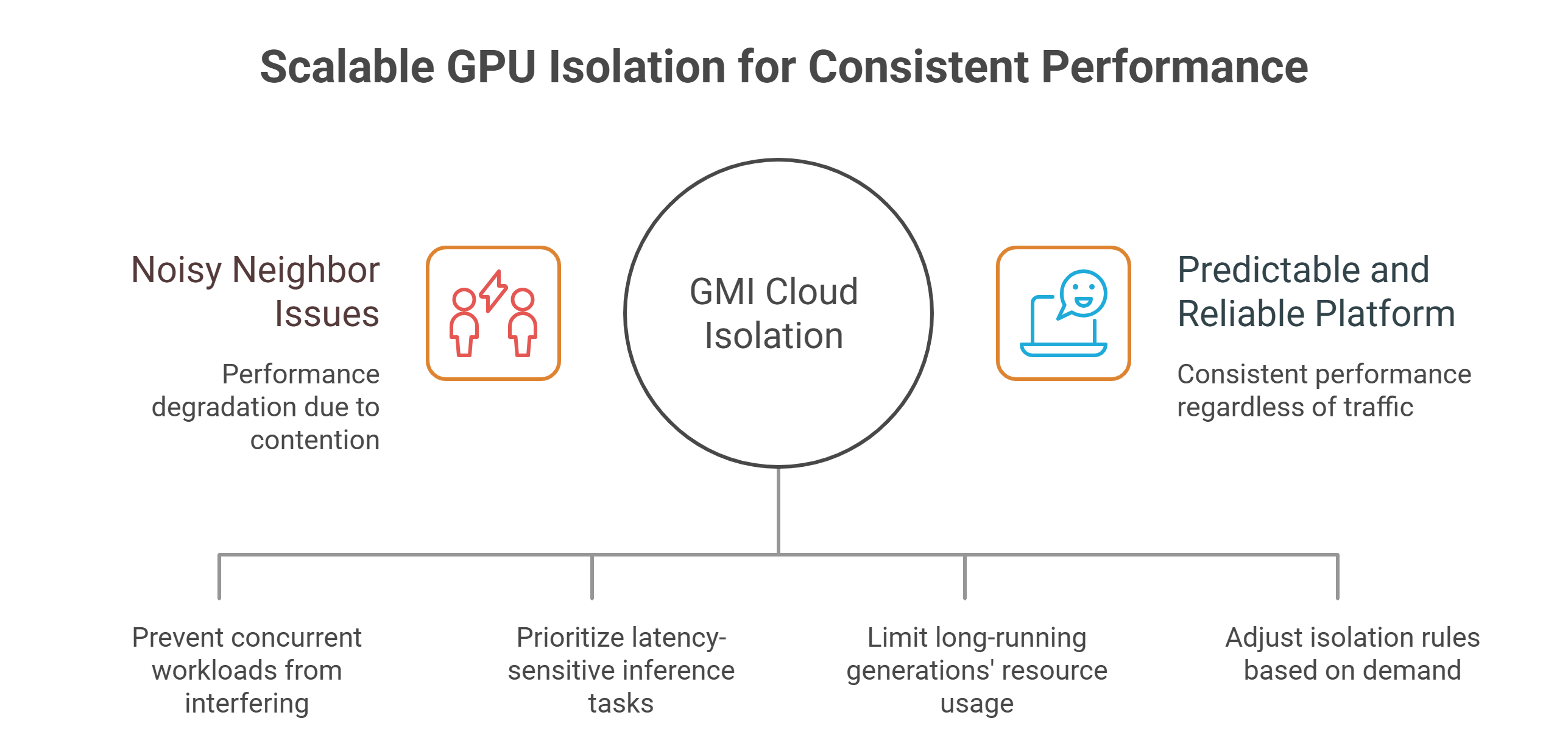
As concurrency increases, isolation rules adapt dynamically, allowing the platform to maintain service quality even during extreme load.
For builders, this means fewer surprises. Performance remains consistent regardless of how traffic fluctuates.
Parallel execution for multi-step inference workflows
Many modern AI applications rely on multi-step inference rather than single forward passes. A generation may be evaluated, refined, regenerated and filtered before returning a result. In agentic systems, this loop may repeat several times per request.
Sequential execution quickly becomes untenable under concurrency. Latency compounds and queues explode.
GMI Cloud executes these workflows in parallel whenever dependencies allow. Independent steps run concurrently across GPUs. Speculative execution reduces wait time. Intermediate results are reused intelligently rather than recomputed.
This parallelism turns what would be linear bottlenecks into scalable pipelines capable of handling thousands of concurrent flows.
Network-aware execution at scale
High concurrency amplifies the cost of inefficient data movement. As requests fan out across GPUs, network latency and bandwidth become part of the critical path.
GMI Cloud’s inference infrastructure is built on high-bandwidth networking designed to support large volumes of concurrent data exchange. Requests, tensors and intermediate results move predictably between execution stages without congesting the system.
This network awareness is especially important for multimodal and creative pipelines, where large artifacts like images, embeddings and latent representations must flow smoothly under load.
Elastic scaling without cold starts
Concurrency is rarely constant. Traffic spikes, drops and shifts unpredictably. Systems that rely on static capacity either overpay during quiet periods or fail during peaks.
GMI Cloud scales inference capacity elastically, bringing GPU resources online as concurrency increases and releasing them when demand falls. Crucially, this scaling is designed to avoid cold-start penalties that can cripple responsiveness.
Warm execution pools, intelligent preallocation and fast scheduling ensure that new capacity integrates seamlessly into the inference fabric. From the perspective of users, performance remains stable even as underlying resources change.
Observability tuned for concurrency
Handling high concurrency requires visibility. Teams need to understand how requests behave under load, where latency emerges and how efficiently GPUs are utilized.
GMI Cloud provides observability focused on inference behavior, not just infrastructure metrics. Builders can see throughput, latency distributions, queue depth and utilization patterns across concurrent workloads.
This insight enables teams to tune models, adjust pipelines and plan capacity with confidence instead of guesswork.
Built for creators, not just operators
While high-concurrency inference is often discussed in enterprise terms, it is increasingly relevant to creative AI builders. Visual generation tools, collaborative platforms and real-time creative systems must support many users iterating simultaneously.
GMI Cloud’s infrastructure is designed to support this mode of creation. High concurrency does not force creators to compromise on quality, resolution or workflow complexity. Pipelines scale transparently as usage grows.
This is particularly powerful when combined with GMI Studio, where visual workflows can be executed concurrently at scale without local GPU limits or fragile setups.
Concurrency as a creative enabler
High-concurrency inference is not just a performance challenge. It is a creative constraint.
When systems handle concurrency well, teams can open products to more users, run more variations and iterate faster. When they do not, creativity bottlenecks around infrastructure limitations.
GMI Cloud treats concurrency as a first-class design principle, not an afterthought. By combining intelligent scheduling, adaptive batching, multi-model routing, parallel execution and elastic scaling, it enables AI systems that remain responsive and predictable under real-world load.
For builders creating the next generation of AI products, handling concurrency is not optional, and the right inference architecture makes the difference between scaling ideas and stalling them.
High-Concurrency Inference on GMI Cloud: FAQs for Production Teams
1. Why do inference systems often fail under high concurrency even if a model performs well in isolation?
Because real traffic changes everything. When many requests arrive at once, latency can spike, queues become unpredictable, GPUs can end up poorly utilized, and costs drift upward. High concurrency exposes scheduling, routing, and orchestration weaknesses that don’t show up in single-user testing.
2. Why does GMI Cloud treat concurrency as a scheduling problem before a scaling problem?
Because adding GPUs alone doesn’t fix head-of-line blocking, contention, or mixed request behavior. Under load, requests differ in size, latency sensitivity, memory footprint, and pipeline depth. GMI Cloud decomposes, prioritizes, and routes requests based on execution characteristics so interactive traffic stays predictable even during spikes.
3. How does GMI Cloud use batching without making responses feel slow?
It uses adaptive batching. Batch sizes are adjusted dynamically based on traffic patterns, model behavior, and latency targets. Interactive requests are grouped just enough to improve GPU utilization without breaking responsiveness, while background or asynchronous workloads can batch more aggressively for efficiency.
4. How does GMI Cloud handle multi-model inference pipelines under load?
Instead of forcing everything through one path, it routes requests across specialized models running concurrently. Lighter stages like embeddings, reranking, or filtering can be dispatched to appropriate resources, while heavy generation steps are isolated on GPUs suited to their memory and compute needs, preventing a single model or GPU class from becoming a bottleneck.
5. How does GMI Cloud prevent “noisy neighbors” when concurrency spikes?
It enforces isolation at the scheduling level so heavy bursts don’t degrade everyone else. Latency-sensitive inference paths are protected from background processing, and long-running generations can’t monopolize GPU time. As load increases, isolation rules adapt so performance stays consistent even during extreme traffic.
Build AI Without Limits
GMI Cloud helps you architect, deploy, optimize, and scale your AI strategies
FAQ
Because real traffic changes everything. When many requests arrive at once, latency can spike, queues become unpredictable, GPUs can end up poorly utilized, and costs drift upward. High concurrency exposes scheduling, routing, and orchestration weaknesses that don’t show up in single-user testing.
